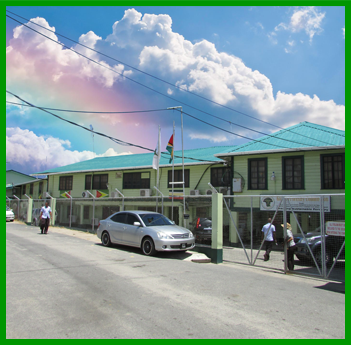
Guyana's Forests
Nearly 165,000 km2
or seventy-five percent of Guyana's land area is covered with natural
vegetation. The Guyana Forestry Commission is responsible for the
management of approximately 136,000 km2 classified as State
Forests. The remainder of the forested areas are either State Land,
Amerindian Land or private property

The GFC is currently involved
in several projects to effectively manage the forest's resources. The details
are available in the Projects section of this
website.
Forest Values
The forest plays an important role in watershed protection. Water conservancies
have been established for the supply of irrigation water upon which the
agricultural industry is dependent. Watersheds that supply these conservancies
are mostly white sand areas where much of the forest cover has been lost due to
bauxite mining, agriculture and the intensive harvesting of fuelwood. Annual
flooding of low lying coastal areas is a frequent problem attributed in part to
this forest clearance. It is important that the watersheds are put under a
multiple-use management regime with the primary management objective being the
maintenance of good watershed characteristics.
The biodiverstiy of the
forests has been the subject of a number of surveys and studies, mostly by
foreign universities and institutions. The Smithsonian Institute which has
co-operated with Government in the establishment of a Biodiversity centre in
Guyana, has conducted systematic studies of the flora and fauna. A National
Biodiversity Strategy has been approved by Cabinet which establishes national
regulations governing the prospecting of biological and genetic resources and
protects intellectual property, particularly of the indigenous Amerindian
people.
Classification of the Forests
Rain Forests

Rain forests occur in areas
where the climate is wet, with rain occurring every month or where dry spells
are short. Trees are numerous and stand in strata or layers, ranging from low
shrubs to very tall dominant trees with large spreading crowns. Climbers and
epiphytes are abundant. In Guyana, rain forests are the most common forest
type, occurring from the north-west through to the south of the country. It is
also the most important type for timber production.
Seasonal forests (also known
as monsoon forests) occur where there are regular dry seasons. Trees are not as
tall and the top of the forest canopy is more even. In the dry season, the
larger trees often lose their leaves. Climbers and epiphytes are less abundant.
Seasonal forests are found in Guyana in the north Rupununi and the upper Berbice
areas.
Dry Forests

Dry forests occur where soil
moisture is frequently limited either because the soil drains rapidly or where
there is excessive evaporation due to strong winds. Examples of dry forest are
found on the white sands of the Soesdyke-Linden highway and throughout the
Pakaraima Mountains. Wallaba forests (as seen in the picture above) are common
in the white sand regions.
Seasonal Forests

Swamp forests (see picture)
occur where drainage is impeded and soils are frequently waterlogged. This
forest type includes the mangrove forest along the coastline and the Mora
forests occurring in lowland swampy areas and along the interior.
Mangrove forests provide
protection to the shoreline against erosion and are an important habitat for
marine life. Removal of mangroves for fuelwood from the Essequibo River to the
Corentyne has not only exposed lengths of coastline to erosion but also degraded
these ecosystems, limiting their ability to act as nurseries for pelagic fish
species ( an estimated 75 percent of fish caught commercially spend some
time in the mangroves or are dependent on food chains which can be traced back
to these coastal forests). Mangrove plants and sediments have also been shown to
absorb pollution, including heavy metals. Mangroves along the north-west coast
are still largely intact. An evaluation of the mangrove resource is to be
carried out by the Guyana Forestry Commission and plans for its protection and
management are to be developed.